
Emerald Mobile Notary Service provides individuals and businesses in the greater Fairfax Virginia area with exceptional notary services.
Mobile Hospital Notary Services in Northern Virginia
Emerald Mobile Notary Service provides professional services throughout Northern Virginia, including Fairfax, Falls Church, Arlington, Reston, and surrounding communities. I travel directly to hospital rooms for bedside notarizations involving powers of attorney, adance directives, estate planning documents, wills, trust documents, and real estate paperwork. If you need a mobile notary at Inova Fairfax Hospital, Inova Fair Oaks Hospital, Virginia Hospital Center, Reston Hospital Center, or the Inova Schar Cancer Institute, you can call on me to provide experienced in-person notary services at your convenience.

Need a mobile hospital notary in Northern Virginia?
Call or text June Siegel-Hill at 703-577-5484 to schedule a bedside notarization visit.
Bedside Notarization Services at Northern Virginia Hospitals
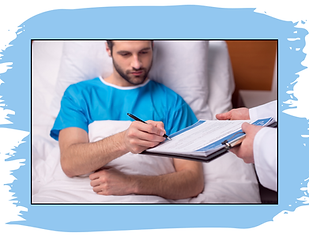
Compassionate Bedside Notarization Services
You may have tried to reach the the notary on staff at the hospital, but their policy says that they are limited in the types of documents they can notarize. They can only handle medical-related paperwork, so they won't be able to notarize a will, power of attorney, trust documents, financial or real estate transactions.
I understand that being a hospital patient or family member can be a stressful and uncertain time. You may need to sign documents that are often time-sensitive, and I can help simplify that piece of the process for you.
I will come to your room for a bedside notarization or to a common area in the hospital if you prefer. I am responsive and offer flexible scheduling. Same-day visits are often possible.
Common Documents Notarized in Hospitals
Powers of Attorney
A mobile hospital notary can assist patients and families with notarizing financial and medical powers of attorney while the signer is alert, willing, and able to communicate clearly.
Advance Medical Directives and Living Wills
These documents specify what type of medical care you want if you're unable to communicate with your doctor at or near the end of your life. They also allow you to pick an agent for yourself when you are unable to make health decisions for yourself.

Estate Planning Documents and Trusts
Estate planning documents organize your life information and states who gets or is in charge of handling the assets and responsibilities that currently belong to you in the event of an emergency or your death.
Real Estate and Financial Documents
This is legally binding paperwork that formalizes the buying, selling, leasing, or financing of property. This includes closing documents for a purchase or sale of real estate: mortgage, deed and title documents, and disclosures.
Common Challenges During Hospital Notarizations

Hospital patients often need to sign documents in their most emotionally- and physically challenged times.
Some unexpected issues may arise. A few of the most common issues in hospital signings are listed and described below, and they are all to be considered by the notary at the time of signing:
-
Signer alertness and awareness
-
When valid ID is unavailable
-
Witnesses are not available
-
Patient is physically unable to sign
* In order to avoid these challenges, please see my two-page document called, Prepare for a Successful Signing.
-- Signer Alertness and Awareness
The patient must be alert and aware in order to have their signature notarized on a legal document. As it is the notary's responsibility to assess a signer's awareness, I may ask questions to determine if the patient understands the purpose of the document.
The patient may be fatigued as a result of pain medication. You may consult with nursing staff to see if any medication would impair their ability to sign. If you know the patient's medication schedule, it's helpful to schedule their signing at the time of day when they are most alert.
Another issue is the patient's willingness to sign their documents. The notary must be satisfied that the signer is aware of the transaction and is acting without duress. I abide strictly by Virginia law and cannot make exceptions.
-- When Valid Identification is Unavailable
All signers whose signatures are to be notarized need to provide a valid form of identification (example: driver's license or passport) at the appointment. See the list of acceptable forms of ID on my homepage.
If the patient's ID is not available, please notify me so we can make an accomodation. In Virginia we can make use of two credible witnesses, who are impartial individuals who know the signer and take an oath swearing to the signer's identity. They cannot have any financial interest in the document.
-- Witnesses are Not Available
If the patient is signing documents such as a last will and testament, an advance medical directive, or even trust documents, two impartial witnesses, who are 18 or over, are required to be present. This should be confirmed on the phone when scheduling the appointment. Witnesses must also provide their valid ID at the signing.
It has been my experience at the hospital that staff are usually not allowed to act as witnesses. They should not be counted on to act as witnesses.
-- Patient is Physically Unable to Sign
If the patient is physically unable to sign, but is alert, coherent, and willing to sign, they may sign their documents with an 'X' or a similar mark in lieu of a signature. In Virginia this is called "signature by mark." This must be done in front of two witnesses, and their signature can be notarized.
The signer must be able to make the mark on their own, and no one may physically hold or guide the signer's hand to make a signature.
Frequently Asked Questions for Hospital Notary Visits
Q. Can a notary come directly to my hospital room?
A. Yes, a mobile hospital notary can travel directly to a patient's hospital room to notarize important documents such as powers of attorney, advance medical directives, trust documents, or other legal paperwork. This notarization service is designed to provide convenience for patients and families throughout Northern Virginia during difficult or time-sensitive situations.
Q. What identification is required for a hospital notarization in Virginia?
A. For a hospital notarization in Virginia, the signer is typically required to present a valid, government-issued photo ID such as a driver’s license, state identification card, passport, or military ID. The identification should be current or otherwise acceptable under Virginia notary law and must reasonably confirm the signer’s identity. Please note that a digital form of ID is not considered a valid ID in Virginia.
Q. Can hospital staff serve as witnesses?
A. Most hospitals restrict staff participation as witnesses in signings. Certain legal documents may require witnesses who are disinterested parties and not involved in the patient's care, so it is best to arrange for your own witnesses. If an attorney has prepared your documents, it is helpful to confirm witness requirements with them when possible.
Q. How quickly can a hospital notary be scheduled?
A. Hospital notary appointments can often be scheduled the same day or within a short period of time, depending on availability and travel distance. Because these appointments are frequently time-sensitive, I make every effort to accommodate urgent requests whenever possible. It is helpful to have the documents prepared in advance and to confirm that the signer is alert, willing to sign, and has acceptable identification available.